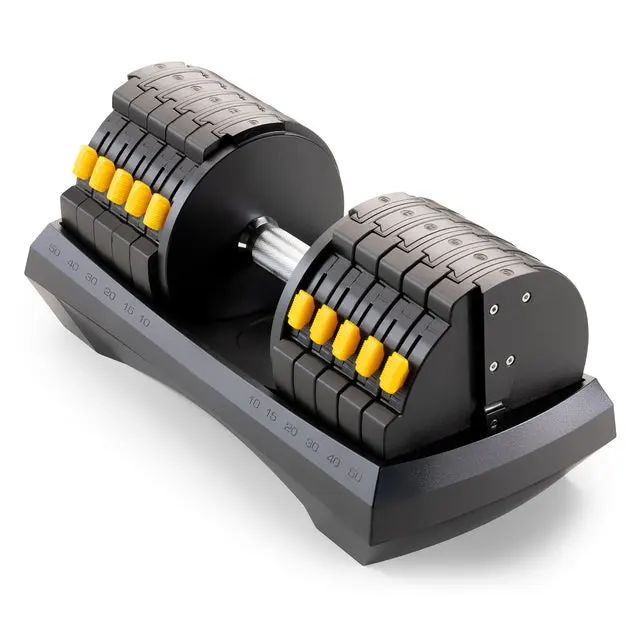
Fixed and adjustable dumbbells solve different equipment problems. Fixed pairs keep a selected weight ready to use, while an adjustable system concentrates several settings in a smaller collection of handles and plates. Neither format is automatically the best choice for every home gym. Think about your available storage, the speed at which you change weight, the heaviest and lightest movements in your routine and whether several people train together. These questions are more useful than comparing only the maximum advertised weight.
Map your actual weight range
Write down the approximate range needed for each exercise and identify where small increments matter. The best range for rows may differ from the range for lateral raises. Check the complete sequence of settings, not just the endpoints. Some adjustable systems change in uneven steps or require an additional kit to reach their maximum. For fixed pairs, calculate the total number of dumbbells and the storage needed. Include the light pairs you use regularly rather than spending the entire budget on the heaviest option.
Compare changes during a session
Dial, pin and plate-loaded systems each have a different adjustment process. Ask for a demonstration showing how the setting is selected, checked and lifted from its cradle. Confirm whether both ends must be adjusted and whether plates remain secure when used as instructed. Fixed dumbbells are straightforward to select, but retrieving the right pair still requires an organized rack. For circuits or shared training, consider whether one adjustable pair would become a bottleneck.
Look at shape and handle feel
The overall length of a dumbbell can affect how closely the hands move during some exercises. Check whether its length stays constant at lighter settings or changes with the selected weight. Compare handle diameter, usable grip length and surface texture. Hexagonal heads, round heads and enclosed adjustable frames can feel different against the body or when resting between movements. A photograph does not communicate all of these details, so ask for dimensions and, where possible, try the handling yourself.
Understand handling restrictions
Read the manufacturer's rules on setting the weights down, dropping, supporting body weight and using the dumbbells with accessories. An adjustable mechanism may have restrictions that differ from those of a fixed product. A rubber exterior alone does not establish that any dumbbell is designed for dropping. Check instructions for the exact model and follow them. If a movement requires the dumbbell to act as a stable support, verify that this use is specifically permitted before including it in the purchase decision.
Count the complete storage footprint
Adjustable dumbbells still need a secure landing space for their trays and any unused plates. A stand may improve access but uses additional floor area. Fixed pairs need a rack matched to their dimensions and the manufacturer's load limits. Measure the reach required for the lightest and heaviest pairs. Avoid placing a heavy item where it must be lifted past another weight or around an obstruction. A tidy arrangement should make returning equipment as simple as selecting it.
Compare repairability and total cost
Ask whether replacement handles, cradles, locking components and plates are available. For fixed pairs, check how a damaged single dumbbell can be replaced. Include stands, additional expansion weights, delivery and warranty conditions in the comparison. A lower starting price can be misleading if the required range needs a costly upgrade. Conversely, a full fixed set may be unnecessary if you mainly use a small selection of weights and train alone.
A short inquiry checklist
- Full weight sequence, units and whether the price is per dumbbell or per pair.
- Handle dimensions, overall dimensions at light and heavy settings, and storage requirements.
- Instructions for adjustment, permitted handling and inspection.
- Included trays, stands, collars or expansion parts.
- Availability and cost of replacement components.
Choose fixed pairs when ready access and shared use justify the space. Choose an adjustable system when its weight sequence, handling rules and change process fit your routine. Check the details of the individual product in either case.

Have something helpful to share? Be the first to join the conversation.