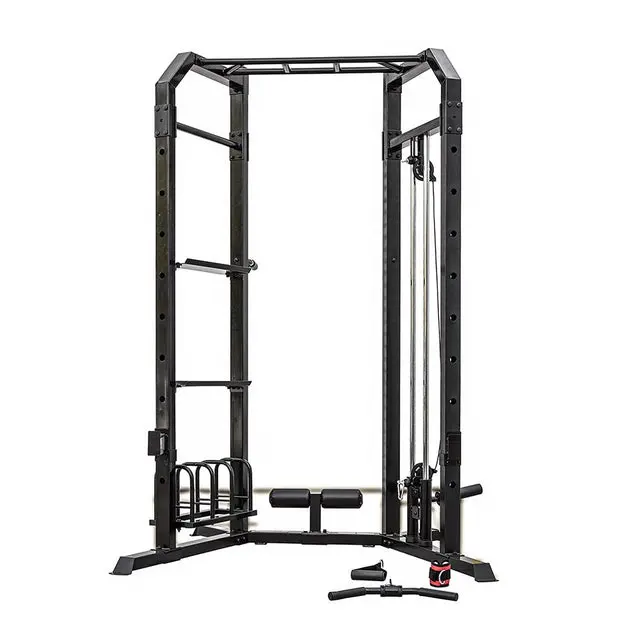
A power rack should be selected as a system: frame, bar supports, safeties, anchoring method and compatible accessories. Upright size and a large advertised capacity are useful starting details, but they do not answer every question about a complete setup. Begin with your barbell movements, the room and the way you train. Then compare exact models using their installation instructions and included parts. A rack that supports a straightforward routine reliably can be a better purchase than a larger frame with accessories you cannot use in your space.
Match the format to the room
A full cage provides an enclosed lifting area, while a half rack or squat stand uses a different layout. A folding rack can recover floor space between sessions, but still needs working room when open and a suitable mounting surface. Compare the full installed footprint, including rear stabilizers, storage pegs and loaded plates. Check ceiling clearance for the rack and for any intended pull-up movement. Do not assume that a shorter rack preserves the same usable height or exercise options.
Understand the safety system
Confirm which safety devices are included and which are additional purchases. Pin-and-pipe safeties, straps and spotter arms differ in adjustment, coverage and compatibility. Ask the supplier to identify the correct setup for the exercises you plan to perform. An accessory rating should apply to the particular accessory and installation, not merely the rack frame. Follow the manufacturer's placement and use instructions. A high static capacity claim does not establish how an unspecified configuration will behave if a loaded bar falls.
Check dimensions beyond upright size
Attachment fit depends on hole diameter, hole spacing, upright dimensions, orientation and sometimes hardware details. Two products described with the same nominal upright size are not necessarily interchangeable. Ask for an explicit compatibility list by model. Check that J-cups can be placed at a practical height and that the bench fits between the uprights. With an existing bar, confirm the distance between the sleeves works with the rack width. Photographs can help, but a dimensioned drawing is more useful.
Decide how it will be secured
Some designs require anchoring; others have instructions for freestanding use or specific stabilizers. Obtain those instructions before choosing a location. Check whether the floor can accept the prescribed anchors and whether floor mats affect installation. Adding a cable attachment, dip handle or storage system can change the intended configuration, so ask about the whole assembly. Keep mounting and load-bearing decisions tied to the equipment documentation and the building rather than improvising from another owner's setup.
Evaluate everyday adjustments
Look at how supports and safeties move, whether positions are clearly marked and whether a single person can adjust them comfortably. Protective inserts can reduce metal contact, but they do not remove the need to inspect wear. Consider how often different users will change heights. If you intend to move between squats and bench work, verify that the bench can be positioned without colliding with a rear crossmember or storage plates. Include time spent rearranging the setup in your assessment.
Buy useful expansion
A cable attachment, landmine or extra storage can expand a rack, but each needs space and may require other parts. Price the complete configuration rather than only the base frame. Ask about future availability of wear parts, replacement J-cup liners and model-specific accessories. Avoid paying for expansion potential that depends on an unconfirmed attachment standard. Keep a record of the exact frame generation because suppliers sometimes revise compatible components without changing the broad product family name.
Questions for the supplier
- What safeties, supports and stabilizers are included in this exact package?
- Is anchoring required for the proposed configuration and floor type?
- What are the installed dimensions and required operating clearances?
- Which bars, benches and accessories have confirmed compatibility?
- What installation manual, warranty terms and replacement parts are available?
Choose the rack only after the answers form a coherent setup. A clear installation plan and compatible safety equipment deserve more weight than a long feature list.
Have something helpful to share? Be the first to join the conversation.