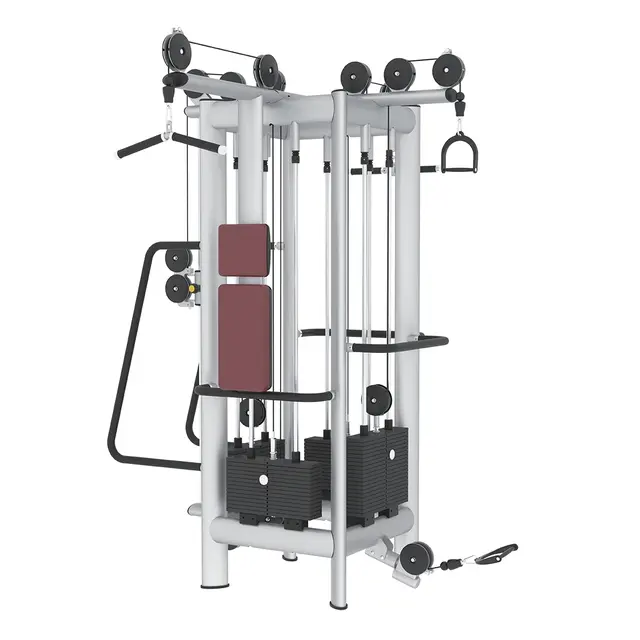
Cable machines are often advertised by the size of their weight stacks and the number of possible exercises. Those figures do not fully describe how the machine will work in your room. Pulley arrangement, cable travel, trolley positions and the space between the towers all influence the movements available. Begin with a shortlist of exercises and compare each machine against that list. The most capable-looking station is not necessarily the best fit if its working range or layout conflicts with the way you intend to train.
Clarify what the weight number means
Ask whether the quoted stack weight applies to one stack or the whole machine. Then ask for the cable ratio and the manufacturer's stated resistance at each handle. In an ideal two-to-one arrangement, handle force is approximately half the selected stack weight, but friction and the actual configuration affect the feel. Treat that relationship as a way to understand the specification, not a calibrated measurement of a particular machine. Compare suppliers using the same definition of resistance.
Check usable cable travel
Cable travel describes how far the handle can move before the system reaches its intended limit. It is separate from the height of the tower. Ask for the available travel for the exercises you intend to perform, including any differences when handles are connected together. A movement requiring a long step away from the machine may need more room and travel than a short pull near the tower. Do not infer these limits from an exercise diagram alone.
Review the trolley positions
Look at the highest and lowest usable pulley positions and the spacing between adjustments. A tall user and a shorter user may need different positions for the same movement. Ask how the trolley releases and locks, whether the position indicators are clear and how the adjustment feels with the cable unloaded. Confirm the intended procedure in the manual. Multiple positions are valuable when they provide useful alignment, rather than simply adding a large number to the feature list.
Draw the working area
Measure the frame, its stabilizers, the path of the handles and the space occupied by the person exercising. For a two-tower setup, check the distance between pulleys and the opening available for a bench. Consider nearby doors, mirrors, other machines and routes through the room. A corner placement can save visual space while restricting certain movements. Ask the supplier for operating clearances and a layout that includes the bench or other equipment you plan to use with the machine.
Check attachments and combined functions
List what is included: handles, bars, ankle straps, storage hooks and any connection accessories. Confirm their rated compatibility with the station. An integrated rack, Smith bar or lat pulldown may add useful functions, but each can have separate limits and setup requirements. Ask how switching functions changes the available space and whether more than one person can use the machine at once. Price the full setup rather than assuming that every pictured attachment is supplied.
Make service access part of the layout
Cables, pulleys, guides and adjustment components need inspection and eventual replacement. Ask how panels are removed, how replacement cables are specified and whether parts are stocked for your model. Check how much access is required behind and beside the frame. A tight installation that makes maintenance difficult can create a continuing inconvenience. Obtain the maintenance schedule and use only the cleaning or lubrication products that the manufacturer recommends for the relevant components.
Questions that make quotations comparable
- Stack weight per side, cable ratio and stated handle resistance.
- Usable cable travel and the trolley adjustment range.
- Full installed dimensions and clearances for the planned exercises.
- Included attachments, permitted configurations and user limits.
- Installation requirements, service access and replacement-cable availability.
A good cable-machine comparison explains what you can perform comfortably in the available space. The stack number is one part of that explanation, not a substitute for it.
Have something helpful to share? Be the first to join the conversation.